Key Takeaways
- Pre-Shipment Inspection (PSI) Prevents Costly Claims: Catching defects at the factory floor eliminates cross-border logistics losses, container hold-ups, and customer rejection costs upon arrival at U.S. ports.
- Workflow Integration is Essential: Inspection should not be a single event; it must be structured across an order workflow that spans pre-production sample approval, line QC, packaging, and loading .
- Differentiate Criteria by Product Technology: Standard particle quartz requires strict color consistency and surface flatness , while full-body printed or heavily veined quartz requires verification of edge veining continuity and slab thickness penetration .
- Audit Origin Documentation Early: U.S. importers must verify origin records—such as mill certificates and export documentation—prior to final balance payment and container departure to satisfy U.S. Customs standards .
1. Introduction: The High Stakes of Quartz Quality Control
For U.S. quartz importers, distributors, and commercial project buyers, sourcing engineered quartz overseas offers significant scale and cost advantages. However, it also introduces substantial operational risks. Once a shipping container clears customs and arrives at a domestic distribution center or fabrication yard, returning defective material is economically unviable. Unusable slabs result in lost freight costs, demurrages, delayed installation schedules, and damaged client relationships.
Quartz quality issues generally fall into three main categories: visual defects (such as color variation, resin pooling, or surface pitting), structural inconsistencies (such as warping, uneven thickness, or micro-cracks), and compliance failures (such as incorrect origin documentation or poor packaging).
To mitigate these risks, leading U.S. stone importers are shifting from reactive post-arrival claims to structured Pre-Shipment Inspection (PSI) protocols. This guide outlines how to establish an effective quartz quality control workflow, verify advanced material features, and audit necessary origin documentation before your cargo leaves the factory.
2. Incorporating Quality Control into the Order Execution Workflow
Effective quality assurance is not an isolated final step; it is an integrated process embedded throughout the manufacturing timeline. Importers who establish clear milestones with their manufacturing partners can prevent structural defects long before slabs are loaded into shipping containers.
The 11-Step Order Execution Framework
A reliable supply chain operation follows a structured 11-step workflow that integrates quality checkpoints directly into production :
- Confirm Quotation
- Receive Deposit
- Approve Pre-Production Sample
- Confirm Production Scheduling
- Production
- Quality Control (QC)
- Packaging
- Receive Balance Payment
- Container Loading
- Shipment
- Provide Shipping & Customs Documents
[Sample Approval] ──> [Production Scheduling] ──> [In-Line & Final QC] ──> [Packaging & Loading]
        │                                                │                        │
  Verify Color/Pattern                             Physical & Visual       Digital Proofs & Origin
   Matching (10x10cm)                               Slab Inspection          Docs Verification
Critical Verification Checkpoints
- Pre-Production Sample Approval: Before bulk pressing begins, buyers should review and sign off on a physical sample. Standard sample sizes (typically $10 \times 10\text{ cm}$) establish the baseline for base tone, aggregate size, and texture . For complex designs, full-slab photos or full-size physical samples are recommended .
- In-Line & Post-Production QC: As slabs pass through calibration, grinding, and polishing lines, inspectors perform automated and manual measurements to check thickness, gloss levels, and surface defects .
- Digital Visual Reporting: Before final balance payments are made and containers are stuffed, factories should provide verifiable photo and video documentation . This tracking package must include high-resolution slab-by-slab photos, bundle labeling photos, packaging details, and container loading videos .
3. Technical Verification Criteria: Slabs, Edges, and Technology
Different engineered quartz collections require tailored inspection strategies based on their manufacturing technology and intended market application.
                  ┌─────────────────────────────────────────┐
                  │     Quartz Inspection Framework         │
                  └────────────────────┬────────────────────┘
                                       │
         ┌─────────────────────────────┴─────────────────────────────┐
         ▼                                                           ▼
┌─────────────────────────────────┐                         ┌─────────────────────────────────┐
│ Classic / Solid Collections     │                         │ Printed / Full-Body Collections │
├─────────────────────────────────┤                         ├─────────────────────────────────┤
│ • Base color consistency        │                         │ • Through-body vein penetration │
│ • Uniform particle distribution │                         │ • Edge pattern continuity       │
│ • Surface flatness & gloss      │                         │ • Natural quartzite realism     │
└─────────────────────────────────┘                         └─────────────────────────────────┘
Classic and Solid Quartz Collections
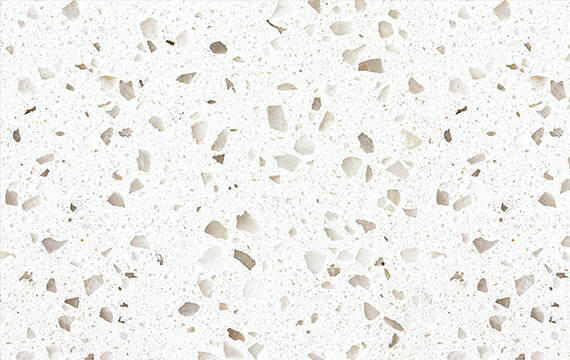
Classic quartz collections utilize traditional engineered-quartz styles with a solid base color, uniform fine dots, or light background aggregate . These materials are widely specified for commercial interiors, minimalist projects, kitchen countertops, and vanities where overall spatial consistency is essential .
When inspecting Classic and Solid collections, inspectors must focus on:
- Tone and Color Uniformity: Solid base colors show shade variations easily. Slabs from the same production batch must show zero visible batch-to-batch or slab-to-slab color shifts under standard $6500\text{K}$ daylight lighting.
- Aggregate Distribution: Ensure quartz granules and particles are evenly distributed without dark spots, resin clumping, or foreign contamination .
- Surface Perfection: Check for pinholes, air bubbles, or uneven gloss distribution across the slab face.
Full-Body Printed Quartz Collections
Advanced collections, such as Full-Body Printed Quartz, use digital printing and veining technologies to replicate high-end natural quartzite and marble . These products target premium residential projects, high-end design firms, waterfall islands, and boutique distributors .
When inspecting Full-Body Printed Quartz, quality protocols must verify:
- Full-Body Veining Penetration: Confirm that the vein visual continues beneath the surface and through the full thickness of the slab . This ensures that mitered edges, bevels, and cut edges display continuous natural-looking patterns rather than a blank white core .
- Edge Aesthetics: Inspect cut edges to ensure the vein pattern remains distinct and clearly visible along profiles .
- Pattern Realism: Ensure print resolution is sharp, free of banding lines, and avoids overly repetitive or mechanical patterning across multi-slab layouts .
4. Origin Compliance and Export Documentation Checks
Physical slab quality is only half of the pre-shipment equation. U.S. importers must also perform thorough compliance audits to prevent customs holds, supply chain disruption, or duty penalties under U.S. import regulations.
Verifying Country of Origin (COO)
Due to shifting trade remedies and U.S. Department of Commerce regulations, establishing verifiable origin claims is critical. For instance, manufacturing facilities located in Southeast Asian hubs—such as Meritara's production facility in Kampong Speu Province, Cambodia (operated under Meritara New Material (Cambodia) Co., Ltd)—must maintain complete, traceable production and export documentation .
Pre-Shipment Compliance Document Audit
Before authorizing container loading and releasing final balance payments , importers should inspect and collect the following documentation package :
- Raw Material Invoices & Bills of Lading: Proof that raw quartz sand, resin, and pigments were legally imported and processed at the manufacturing origin.
- Factory Production Logs: Time-stamped manufacturing records tying the specific order batch numbers to the manufacturing facility's operational history .
- Certificate of Origin (COO): Issued by the recognized government authority (e.g., Ministry of Commerce) confirming the physical transformation and origin of the finished slabs .
- Full Shipping Documentation Suite: Draft Bill of Lading (B/L), Commercial Invoice, Packing List showing gross/net weights, and container seal numbers .
5. Comprehensive Pre-Shipment Quartz Inspection Checklist
The following structured table provides an actionable checklist that U.S. importers and third-party QC inspectors can extract and apply directly during pre-shipment factory audits.
| Inspection Domain | Specific Parameter | Test Method / Standard | Acceptable Standard / Tolerance | Risk Level if Failed |
|---|---|---|---|---|
| Dimensions & Calibration | Length & Width | Steel tape measure along 4 sides | $\pm 2\text{ mm}$ against purchase order specs | High (Causes yield loss during fabrication) |
| Dimensions & Calibration | Slab Thickness | Vernier caliper at 8 perimeter points | $\pm 0.5\text{ mm}$ variance across slab | High (Inconsistent seam heights) |
| Dimensions & Calibration | Flatness / Warpage | Precision straight edge across diagonal | $< 1.5\text{ mm}$ deflection over 3 meters | High (Slab cracking during transport/cutting) |
| Visual & Surface Quality | Color & Shade Consistency | Visual check under $6500\text{K}$ light against approved sample | No visible shade delta within batch or across slabs | Critical (Slabs cannot be installed adjacently) |
| Visual & Surface Quality | Surface Defects | Micro-inspection at $1\text{ m}$ distance | Zero pits $>0.5\text{ mm}$, zero resin spots $>2\text{ mm}$ | Medium (Requires localized repair/refinishing) |
| Visual & Surface Quality | Gloss Level | $60^\circ$ surface gloss meter | Spec range: $85\text{--}90+$ gloss units | Medium (Uneven light reflection across surfaces) |
| Advanced Technology | Through-Body Veining | Edge profile inspection | Vein continues through slab thickness & cut edges | High (Unusable for waterfall edge applications) |
| Packaging & Safety | A-Frame Crate Integrity | Visual load check & wood treatment stamp | ISPM-15 fumigated timber, heavy-duty steel bracing | Critical (Container collapse, safety hazards) |
| Origin & Traceability | Document Audit | Cross-match batch numbers & COO | Matching factory origin records & customs compliance docs | Critical (U.S. Customs detention or fines) |
6. Frequently Asked Questions (FAQ)
Q1. How do I verify full-body veining and edge patterns before slabs are packed?
To verify full-body veining prior to shipment, require your supplier to provide close-up, high-definition photography and video of trimmed slab edges . For Full-Body Printed Quartz, inspectors should check edge profiles to ensure the interior veining penetrates through the entire slab thickness and remains clearly visible on cut surfaces . This step guarantees that edge fabrication (such as bullnose or mitered edge cuts) will maintain pattern continuity .
Q2. What digital tracking materials should importers expect from factory QC teams?
A transparent manufacturer provides comprehensive digital tracking at key stages of order execution . This package should include confirmed production schedules, high-resolution slab photos under standardized lighting, physical QC measurement reports, clear photos of wooden A-frame packaging, photos/videos of container loading, and draft Bills of Lading (B/L) .
Q3. What documents are required to ensure origin compliance for quartz shipped from Southeast Asia?
To satisfy U.S. Customs and Border Protection (CBP) standards, importers sourcing from Southeast Asian facilities (such as Cambodia) should obtain a verified Certificate of Origin, mill purchase records for raw material inputs, factory production logs, clear photo evidence of manufacturing at the designated facility, and official export documentation tied directly to the shipping container numbers .
7. Conclusion
Verifying quartz quality before shipment is a crucial strategy for U.S. stone importers, commercial contractors, and distributors. By establishing clear inspection standards, recognizing technological differences between Classic particle slabs and Full-Body printed designs, and requiring complete origin documentation, importers can eliminate unexpected costs and secure reliable product delivery.
To build a resilient supply chain:
- Embed pre-production sample sign-offs and digital progress updates directly into your purchase agreements .
- Enforce standard dimensional tolerances and full-body visual standards during factory inspection .
- Validate origin compliance documentation prior to releasing final balance payments and loading containers .
Adopting these systematic quality control procedures protects your capital, streamlines customs processing, and ensures that every container arriving at your warehouse meets specifications.